Floating Paradises of New Zealand.
Twelve places Kiwis love, and the rest of the world dreams of, each expressed as a magical floating island. Colour them slowly and post them to someone who has been, or someone yet to go.
Two ways in
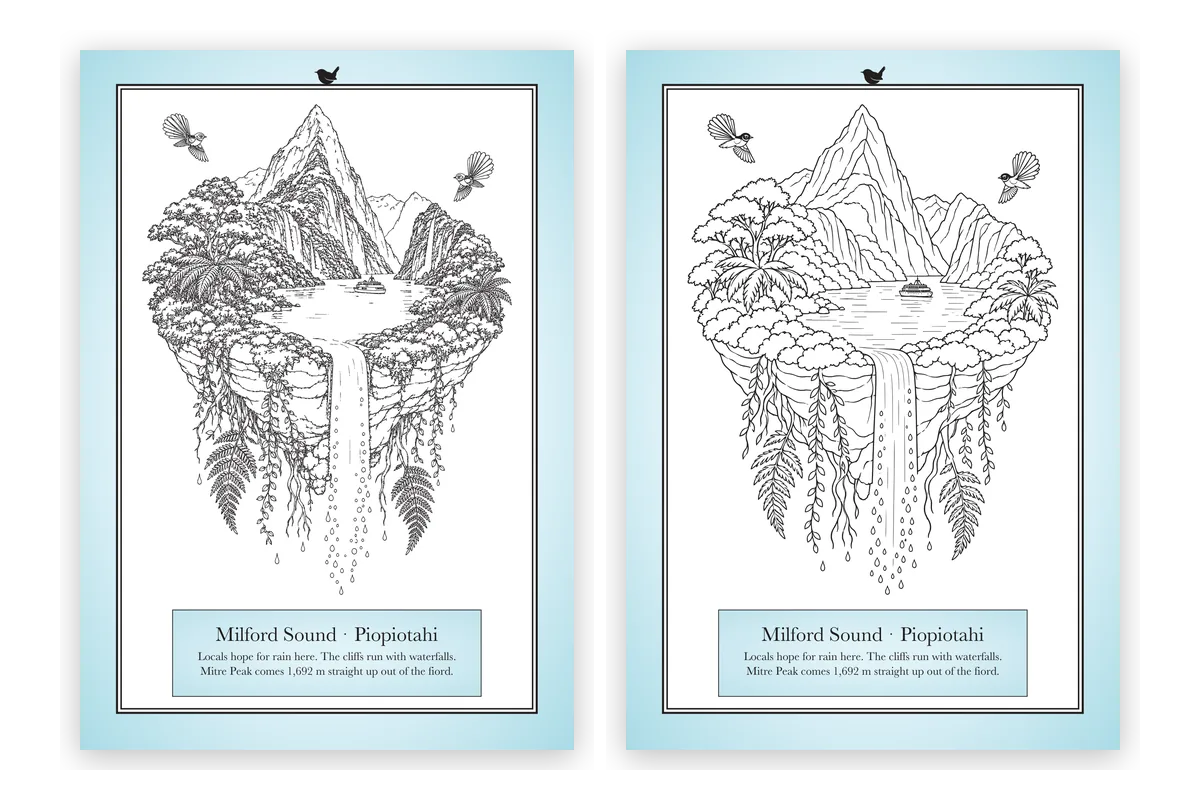
Every place comes two ways. Same twelve islands, your choice of how much there is to colour.
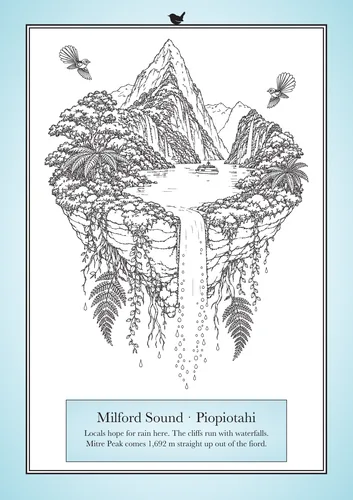 Adventurous
Every root, every leaf, every ripple. If you like to lose an evening in the detail, these are yours. There’s no wrong way to do it, and you’ll probably be surprised at how good they end up.
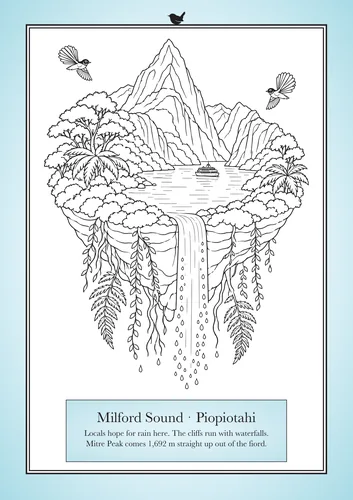 Easy-going
The same twelve places with bigger shapes and fewer lines. For kids, for anyone new to colouring, for the less steady hand, or for the day you really want to stay inside the lines. Just as much fun to colour in.
Buy one twelve and add the other for half price.
The twelve places
Each card carries its place’s name, English then te reo Māori, and two lines a Kiwi would say about it. Here is a little more of each.
Milford Sound · Piopiotahi
Everyone else wants sunshine. At Milford you hope for rain, because then the cliffs run with waterfalls, hundreds of them. The boat feels very small under Mitre Peak, which rises 1,692 m straight out of the fiord. Six to seven metres of rain fall here a year. Pack a raincoat and the sandfly stuff, and go anyway.
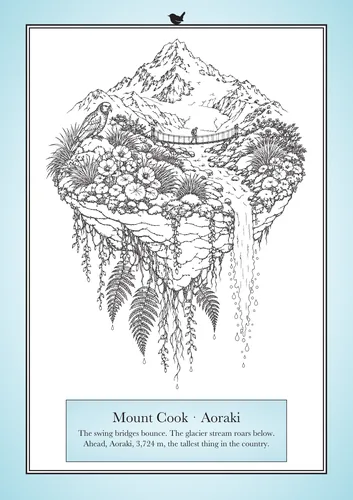
Mount Cook · Aoraki
The Hooker Valley is a walk a lot of Kiwi families know: easy, mostly flat, about three hours there and back, and the swing bridges bounce just enough to set the kids off. At the end of it Aoraki fills the sky, 3,724 m of rock and ice. To Ngāi Tahu it is the most sacred of ancestors. In early summer the world’s biggest buttercup flowers white along the track, and a kea may turn up to go through your bag.
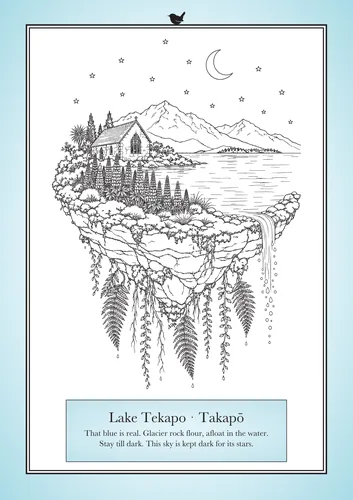
Lake Tekapo · Takapō
Everyone pulls over here on the way through the Mackenzie, and the first time you see that blue you assume someone has fiddled with the photo. They haven’t. Glaciers grind the mountains into a flour so fine it stays floating in the water. It looks like a swim and it is very, very cold. The little stone church has stood on the shore since 1935. Stay till dark if you can: this is part of an International Dark Sky Reserve, the lights are kept low, and the stars are the show.
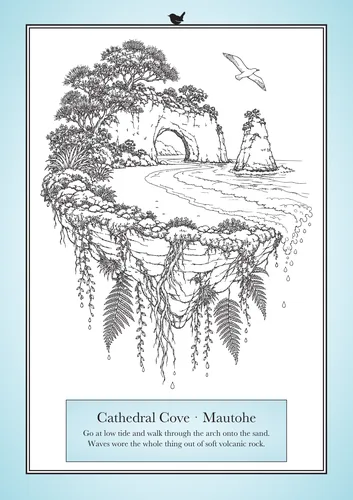
Cathedral Cove · Mautohe
It is a proper Coromandel walk in, forty-five minutes down the hill and longer back up, and worth every step. Go at low tide and you walk through the arch onto the sand, the sea booming in the rock as you pass, and Te Hoho standing on its own out in the shallows. Waves and weather wore all of it out of soft volcanic rock. At Christmas the pōhutukawa along the beach flower crimson. Ngāti Hei hold mana whenua here.
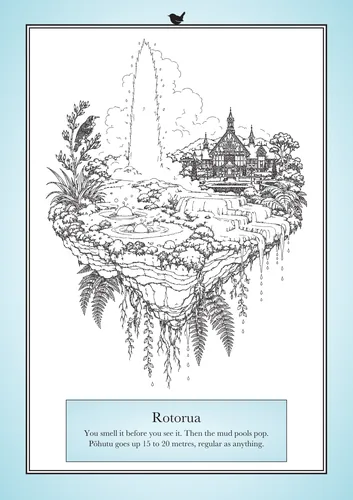
Rotorua
Every Kiwi kid remembers the smell. Then the mud pools, popping away like porridge on the stove, steam drifting across the road, and out at Whakarewarewa the Pōhutu geyser going up 15 to 20 metres, regular as anything. This is New Zealand’s last big geyser field. The water fell as rain at least a hundred years ago. Locals still soak their feet for nothing in Kuirau Park.
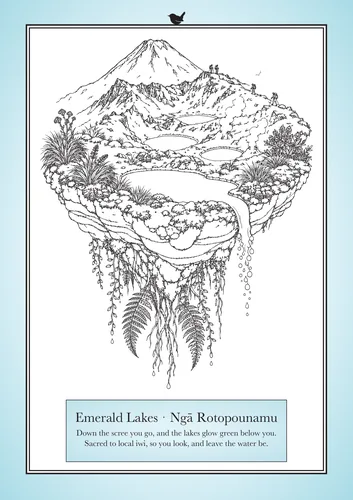
Emerald Lakes · Ngā Rotopounamu
The Tongariro Crossing is the big one: twenty kilometres, up before dawn, and a shuttle waiting at the far end. Past Red Crater you pick your way down the scree with the wind in your face. The lakes glow green below you, sitting in old explosion craters. Minerals washed down from the crater give them the colour, and the name means greenstone-hued lakes. They are sacred to Ngāti Hikairo ki Tongariro, so you look, and you leave the water be.
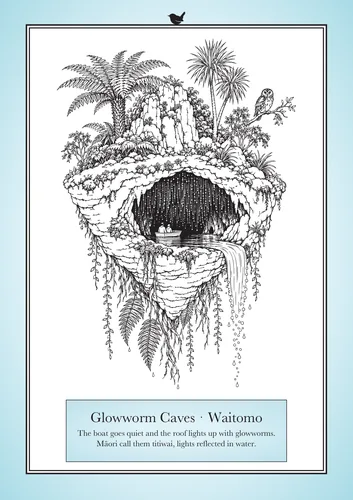
Glowworm Caves · Waitomo
A school-trip classic, and it still gets you. The guide stops talking, the boat glides out onto the dark water, and the roof above you is lit with thousands of tiny blue-green lights. Each glowworm is the larva of a small fly. It hangs silk threads strung with sticky drops to catch whatever flies towards the glow. Māori call them titiwai, lights reflected in water. Nobody says much on the way out.
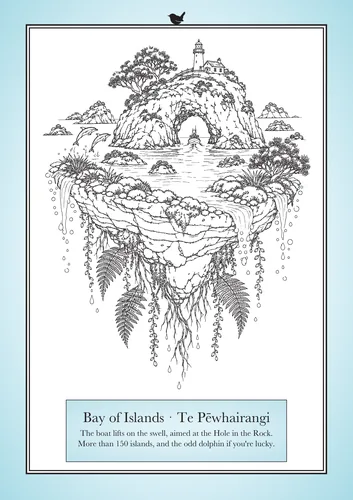
Bay of Islands · Te Pēwhairangi
A good chunk of Auckland heads up here after Christmas, and you can see why. The boat lifts on the swell as it lines up for the Hole in the Rock, and if you’re lucky a dolphin surfaces somewhere off to the side. More than 150 islands sit in this bay of drowned river valleys. Dawn light on the cliffs of Cape Brett helped guide the first waka in, and the Treaty of Waitangi was signed here in 1840.
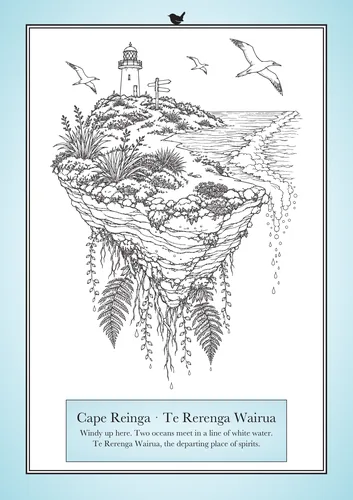
Cape Reinga · Te Rerenga Wairua
It’s a long drive to the top of the North, and it’s windy when you get there. From the rail you watch the Tasman Sea and the Pacific Ocean meet in a long line of broken white water. This is Te Rerenga Wairua, the departing place of spirits, deeply sacred to Māori, so you don’t eat here. Lunch waits down the road at Tapotupotu. The light has been on since 1941.
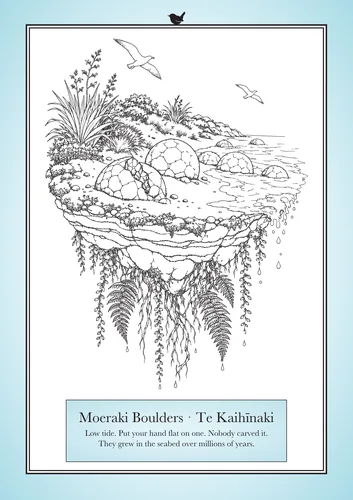
Moeraki Boulders · Te Kaihīnaki
A State Highway 1 stop every Kiwi road trip makes at least once. Go at low tide and put your hand flat on one: cold, smooth, and far too round to be natural, except that it is. Nobody carved them. They grew in the seabed over millions of years, some split open with yellow veins showing, and the sea is still working more of them out of the cliff. To Kāi Tahu they are Te Kaihīnaki, the food baskets and gourds from the wrecked Āraiteuru waka.
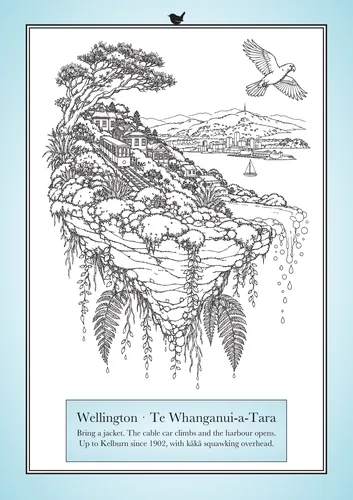
Wellington · Te Whanganui-a-Tara
You can’t beat Wellington on a good day, as the saying goes, and the cable car is the way to see one. It climbs out of Lambton Quay and the harbour opens out behind you, 119 m up to Kelburn, as it has since 1902. Bring a jacket all the same: gusts over 60 km/h blow about 173 days a year. Six kākā were set free at Zealandia, over the hill, in 2002. Their noisy descendants now raid gardens across the city.
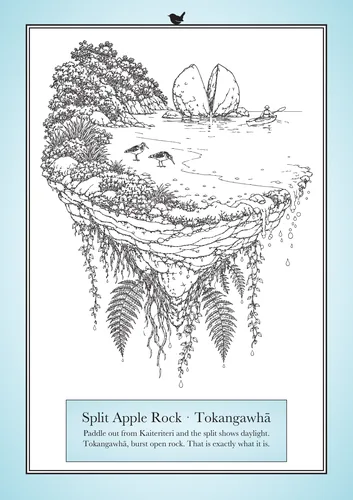
Split Apple Rock · Tokangawhā
Summer at Kaiteriteri means golden sand, a kayak, and a paddle round to the rock. On a still morning you can see daylight clean through the split. Tokangawhā means burst open rock, and that is exactly what it is, a granite boulder in two halves just off the beach. The sand along this coast is the same granite worn fine. Most people see it from the water taxi on the way into Abel Tasman.
Posted from our Cambridge studio, within New Zealand. Orders and returns